
Gaithersburg Previous Residents Sources
Match each source to its era and its question. SDAT is the current assessment and parcel starting point. Maryland Land Records is the route into recorded instruments. Montgomery History, the public library, the Maryland State Archives, newspapers, maps, and plats supply the historical context around a Gaithersburg address. No residents directory source covers every address, and none should be read as a complete resident roster.
| Source | Years it covers | Where held | What it can show |
|---|---|---|---|
| SDAT real-property record | Current assessment record | Maryland SDAT | Owner of record, situs and mailing fields, account/PAN, legal description, values, sale and deed reference. |
| Montgomery land records | Records date to July 1777 | MDLandRec, Circuit Court, MSA | Recorded instruments, grantor/grantee names, book/page, recording date, and images where available. |
| Equity Index Books | 1777-1981 | Maryland State Archives | Separate pre-modern index path for historical land research. |
| Montgomery History collections | Collection-dependent | Montgomery History | Photographs, maps, oral histories, civic records, and local materials. |
| Directories and newspapers | Edition or title-dependent | MCPL, LOC, Chronicling America | A dated printed name, address wording, event, or place reference. |
Begin a recent parcel with the SDAT deed reference. Older chains need patience. Follow the recorded instrument backward, and lean on Maryland State Archives resources, courthouse access, and library or history collections whenever the online path runs out.
Prepare a Gaithersburg Past Address
Save the source version of the address first. Write down the house number, street name, direction, suffix, unit, city label, state, ZIP, postal-route wording, date, and where the address came from. Then build a separate working form. SDAT wants the exact full street name and warns against directional or suffix abbreviations. A USPS postal city can differ from the municipality.
Older research brings variant spellings, renamed roads, route numbers, rural-delivery notation, and house-number changes. Hunt those variants in directories, plats, historical maps, newspapers, and county GIS. Never silently replace a historical address. Keep the original wording in one field. In another field, record the proposed normalization, its source, the date, and a confidence note, so the Gaithersburg parcel trail stays honest.
- Situs address
- The physical property address used in an assessment record. It can differ from a mailing address.
- Parcel or account/PAN
- An assessment identifier that ties a property record to its land-record and map context.
- Legal description
- The land description used in recorded documents. It is often steadier than a street number across address changes.
Note: Keep the source wording and date attached to the address throughout the Gaithersburg research trail, even after a likely modern match turns up.
Montgomery Deed Chain for Gaithersburg
Open the SDAT Real Property Search with an address, street name, account or PAN, or map reference. SDAT will not search by owner name. Owner-name, ZIP, city, neighborhood, and subdivision searches all fail there. Its record shows the owner of record, legal description, parcel or map reference, sales information, and a deed book and page. Treat an SDAT owner entry as an assessment fact. It is not proof anyone lived there.
Carry the deed reference to Maryland Land Records. Remote access requires a verified account, while public workstations at circuit courts and the Maryland State Archives need no such account. The system searches county, party name, instrument type, book and page, date, and, where supported, tax account. Strip the leading zeros from any Montgomery tax-account number. Street-address searching is documented only for Baltimore City, so do not expect the portal to hunt a Gaithersburg street on its own.
- Save the SDAT address form, account/PAN, legal description, deed reference, and date accessed.
- Retrieve the current recorded instrument by book/page or party name and classify its type before drawing a conclusion.
- Record grantor, grantee, recording date, book, page, legal description, prior reference, and any plat, trust, release, or easement reference.
- Search the earlier grantee as a later grantor, checking both sides when an estate, trustee, corporation, or spouse appears.
- Continue backward until a gap needs courthouse, Maryland State Archives, microfilm, or counter research.
- Grantor
- The party transferring an interest in a recorded instrument.
- Grantee
- The party receiving an interest in that instrument.
- Chain of title
- The sequence of recorded transfers traced backward through linked deed references.
Montgomery land records date to July 1777. Images and indexes can lag. A deed may reach the index after book verification while its image follows later, and some instruments, unrecorded material, and other record series sit outside the index entirely.
Gaithersburg Previous Residents and Parcels
Past residents and past owners are separate questions. A deed chain shows how a recorded interest moved. The instrument might be a release, correction, quitclaim, financing document, trust, estate transfer, or corporate transaction rather than a change in who lived at a Gaithersburg address. Compare the legal description against the parcel and recorded plat before deciding two documents describe the same place.
Maryland Plats can identify subdivision, condominium, or survey descriptions, recording context, and digitized images where they exist. A plat anchors lot, road, common-area, or boundary history. It will not name everyone tied to a property. County GIS and historical imagery show how a road, building, or parcel form changed on a dated layer. An aerial image proves nothing, though. It is not an ownership or residency record for any Gaithersburg parcel.
Research tip. Use the SDAT deed reference first when available; it gives a precise starting point that is stronger than beginning with a name-only land-record search.
Gaithersburg Past Residents in Print
Household-level evidence needs its own trail. Directories, newspapers, and other local-history sources can show that a name or institution was printed at an address in a given edition or issue. Directory publisher and year runs vary for Gaithersburg. So locate an actual catalog record or scanned title page before trusting any citation. Preserve the name spelling, street wording, edition, page, publisher, repository, and scan link. The collections and catalog method appear in the Gaithersburg City Directories collection.
Pair the edition with its census release. Then add a newspaper item, a deed or plat reference, and a dated map or photograph. A name can vanish from print. Mark that outcome unresolved. It may signal a move, a new spelling, changed publication practice, or a missing edition. It proves neither death nor a new household.
- Anchor one historical address form to an exact dated directory, newspaper, map, or catalog record.
- Compare the next available dated source for the same spelling and then for documented variants.
- Use a census release or archival source for the wider time period rather than treating a directory as a complete household record.
- Link an address change to a parcel, deed, or plat only after the legal description and date agree.
Gaithersburg Address History Images
Local photographs, maps, oral histories, civic records, manuscripts, and periodicals all sit with Montgomery History research services. Give the staff an address, a date range, and a parcel or deed reference. A former street name helps too. The service itself spells out remote research, scanning, page limits, prepayment, estimates, and a collections move that may affect access. Confirm the current status before sending a request. The Montgomery History research-services page posts the current terms.
Repository items add real color to an address history. Every photograph still needs its own citation. The Montgomery History photograph collection holds nearly 15,000 images of Montgomery County people and places across about 130 years, and each carries its own caption, date, and rights terms.
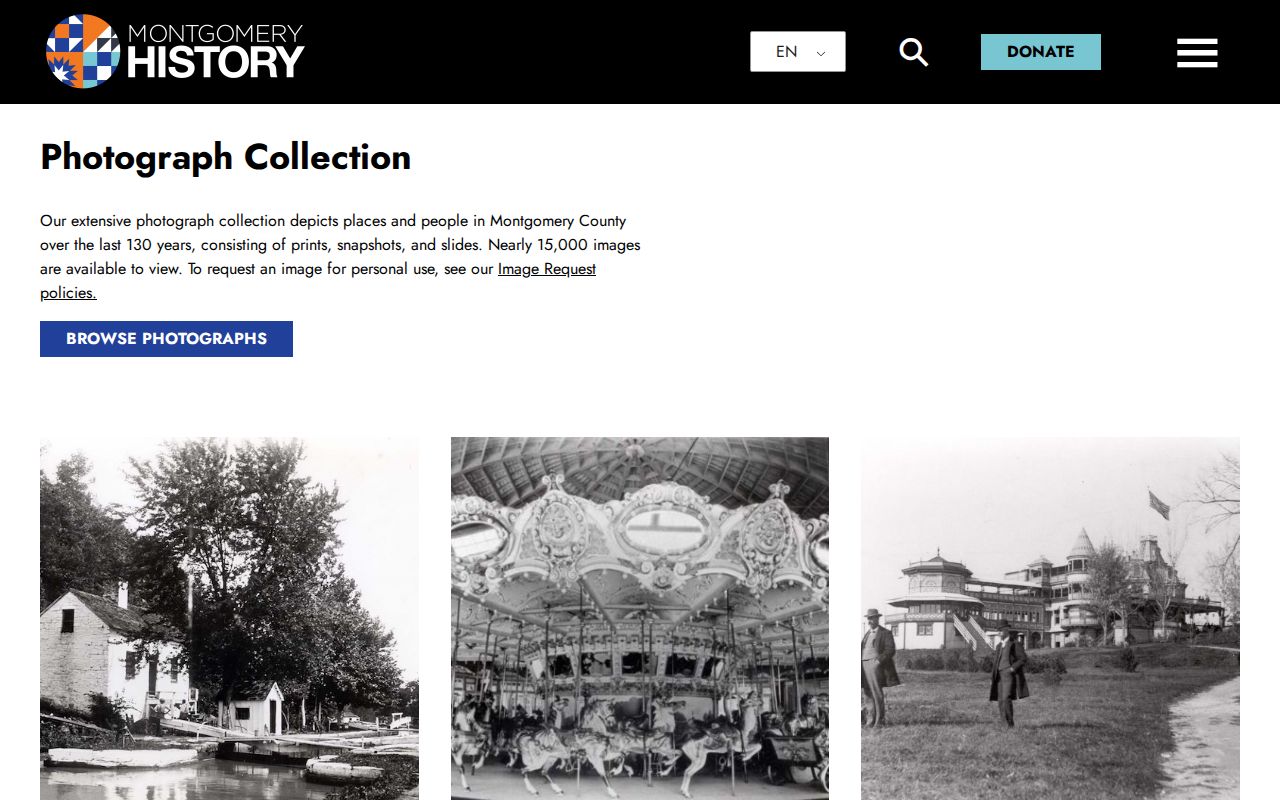
A dated caption can open a real place-history lead. But a caption alone proves neither a person's identity nor a lasting tie to the address.
Montgomery Records Behind Gaithersburg
Why does one old Gaithersburg address trail wind through so many places? Montgomery County kept moving its courts. Sessions started at Leonard Davis Tavern from 1777 to 1779. They then shifted to the Thomas Owen Williams house into early 1783. Later homes for the courts included the 1840 courthouse. More followed, among them the 1891 Red Brick Courthouse, the 1931 fourth courthouse, the 1980 Judicial Center, and the 2014 South Tower. Each move reshuffled storage and public access. Records now sit split across online systems, public terminals, and archival holdings. The series and repository you cite for a past residents lookup stays the constant through all of it.
The courthouse timeline above comes from the county's own account. See the Montgomery Circuit Court recordkeeping history.
An index or image may simply be missing online. Don't assume the historical instrument vanished. Record the court or archival repository the source names instead. Maryland State Archives holds Equity Index Books covering 1777 to 1981 and publishes a Guide to Government Records. Offline routes remain plentiful, including the Circuit Court Public Information Room, court kiosks, Archives workstations, land-record copy requests, MCPL guidance, and archive reference assistance. Each channel can finish a trail the web cannot.
Gaithersburg Previous Residents Limits
Keep a property story about property. Owner of record, directory listing, photograph caption, voter result, and court entry each play a distinct source role. They are not interchangeable. Treat a match as possible only after two independent identifiers line up. Address plus parcel or account works. So do historic name, page, address, and year together. Preserve original spelling, initials, suffixes, and source dates too.
Maryland Safe at Home gives eligible participants a substitute address and mail-forwarding service. Never try to resolve a substitute-address or protection notation to a real location. This work suits family history, local history, and careful property context. It must never track, harass, or expose anyone.
Note: A sound previous-residents result names its source, period, and gap instead of manufacturing certainty.